People’s Liberation Army – Calling The Bluff (Part II)

        So apparently, my previous blog on the PLA Peacekeepers running away under fire in South Sudan (LINK) gathered quite a few eyeballs, being shared on some other blogs, fora and WhatsApp too. This what follows, came as part of a WhatsApp message on my school classmates’ group, not particularly addressed to me. Won’t comment on the authenticity of the message ‘coz I have no way of confirming that. Posting it here for two reasons – Firstly, the tone doesn’t seem too different from the essence of my original blog post and secondly, the need to archive the message in some form.

:BEGINNING OF WHATSAPP MESSAGE:

        This is from the company commander of the 7 Kumaon company in UNMISS, reinforcing sect south. CHINBAT was part of sect south. Before I comment anything on the article (the ‘article’ refers to my blog post quoted above), I must inform you that I was very impressed of Chinese and their abilities when I was serving with scouts and used to assume Chinese as modern and well equipped army. Chinese had made an impression in my mind that they were superior to us. So when I reached Juba to reinforce Sect south we used to see Chinese soldiers in well equipped and modern attire with hi tech equipment. Therefore my belief of Chinese soldier being better to Indian soldier strengthened. So I always used to be afraid of its negative effects on our boys who used to compare own dress, equipment , vehicles, weapons and drills with that of Cinese, because some day same troops may face each other on LAC or the disputed territories.

        Nevertheless, it was the sincere endeavour of my company to practice tactical drills sincerely on daily basis. Focus used to practice reactions to unconventional situations. Hence we evolved non traditional drills. By the time the fighting erupted, each individual of my company was aware and trained in his task and role in his sub unit. During the civil war, Indian company was tasked to reinforce CHINBAT , who were holding the perimeter. By the time No 7 platoon of Indian Company reached the perimeter, Chinese had abandoned their posts and moved back to safer places exposing IDPs to fire from outside. When one of the Chinese officer was asked for the reason they have withdrawn, he said , “It’s not safe out there.” So, Indians had no choice but to plug the breach in perimeter defences, which was done by the Indians in most professional manner and without a scratch.

        Observing Indian tactical drills and there ability to outperform Chinese in holding the perimeter, Chinese were forced to hold balance of the perimeter. Next day, No 8 platoon was tasked to control the refugees who had jumped the fence and infiltrated inside UN compound. Third platoon was also sucked in reinforcing these two platoons and looking after other UN employees who were seeking shelter and food. Next day, When rebel forces were fighting the Govt forces at Northern perimeter, a CHINBAT soldier was busy shooting the war scenes. Ill trained militia aimed and shot a RPG at CHINBAT soldier recording ongoing war from BMP, killing two Chinese soldiers and injuring 5 others.

        But astonishingly, Chinese could manage international media. CNN, BBC, Al Jazeera were running clips of CHINBAT doing battle drills which were previously recorded. Own Media was highlighting the achievements of External Affairs Dept for successfully evacuating 325 Indians. It was known to every south Sudanese​ and UN employee in South Sudan that they were saved by Indian company. Unfortunately, achievement of Indians was neither highlighted by foreign media not own.

        Secondly, Chinese refused to perform the task assigned by force HQ. Task was to evacuate NGO workers who were threatened by south sudan Govt forces. Later on it was revealed that they were raped by Govt forces. I was bit perturbed by insensitive media who could not exploit this opportunity to expose Chinese or to flag achievement of Indian troops on foreign soil. But at the same time when I ask my boys of their opinion about Chinese troops, the war had changed their and my impression or opinion about Chinese. Chinese may be well equipped with technologically superior weapons but at the same time they lack camaraderie, tactical acumen to use / employ tech equipment, and above all fighting spirit. My faith in the abilities of Indian soldier has strengthened many fold. It is due to the abilities of Indian soldier to withstand hardships of war, superior tactics, camaraderie, fighting spirit for unit’s izzat and actual fighting experience in valley or north east.

:END OF WHATSAPP MESSAGE:

        Highlights and font colours are added by me. I thought of adding some comments at the end of the above message, but now I think I think I’d rather not. The message is a brutal commentary on the quality of the PLA soldier that threatens his Indian counterpart across the LAC.

        All I’ll say is that shiny toys are no good, if the boys don’t know how to ‘play’ with them when asked to.

        ’nuff said

SOUTH SUDAN – WHO KILLED THE CHINESE PEACEKEEPERS?

Continuing from my previous BLOG ..

          The previous blog mentioned that two Chinese soldiers were killed during the four days of violence in Juba, prompting the rest of the Chinese troops to run away from their posts. Well, the funeral of the two boys back home was a sombre affair indeed, esp since the Chinese populace is not very used to seeing body bags of their soldiers coming back home because, well, the PLA hasn’t fought at all for nearly four decades since the humiliation at the hands of Vietnam.

        One of the peacekeepers killed was merely 22 years old while the other one was 36 years, both of them, in all probability, the only children to their parents, thanks to the ‘One Child’ policy. This makes the losses even sadder. They would have had huge responsibilities towards their parents and both sets of grandparents who will now have to fend for themselves in their old age. More on that sometime later.

        Coming back to the topic at hand – who killed them? It would in all probability have been the SPLA, or the govt forces, since it is they who were reported to have destroyed the UN compound in vicinity of the Chinese manned post that was later abandoned by those manning it. But digging a little deeper, things get a bit ‘interesting’. Firstly, let us see why the Chinese are there in South Sudan in the first place. The answer? OIL.

        As of 2012, China was consuming nearly 80% of South Sudan’s oil production. This being the case, Chinese sending peacekeepers to South Sudan makes sense – the need to ensure stability and tranquillity in a major source of oil.  But why is Sudan STILL in turmoil despite Chinese outreach ever since the 90s – a time when the USSR no longer existed, and the US was busy elsewhere, getting interested only when its pursuit of terrorists brought Sudan into focus. Part of the answer lies in the previous question itself – CHINA.

        Ever since its outreach to Sudan, even before its partition, China has been arming various groups with reckless abandon and utter disregard to the human suffering brought about by the proliferation of weapons in the country, all in the hope of oil. The human rights violations perpetrated in Sudan are well documented. Human Rights Watch mentioned in a 2003 REPORT titled CHINA’S INVOLVEMENT IN SUDAN: ARMS AND OIL that China supplied not only small arms but even helicopter gunships and tanks, in the hope of recovering the costs in terms of access to oil (more on that later in this blog).

        Amnesty International has been even more pointed in its 2007 report, saying that “Africa has long been the victim of the greed of western governments and companies. Now, it faces a new challenge from China. The Chinese government and Chinese companies have shown little regard for their “human rights footprint” on the continent. The deference to national sovereignty, antipathy to human rights in foreign policy, and readiness to engage with abusive regimes, are all endearing China to African governments. But for those same reasons, African civil society has been less welcoming. The health and safety standards and treatment of workers by Chinese companies have fallen short of international standards. As the biggest consumer of Sudan’s oil and a major supplier of its weapons, China has shielded the Sudanese government against pressure from the international community

        It shows that far from wanting to help Sudan, China has explicitly hurt it instead, by using its membership of the UNSC to veto action aimed at stopping genocide in Sudan. Though in 2007, under threat of an Olympic boycott, China mellowed down its stand, how long that lasted is anyone’s guess. In fact, far from acting against genocide, China actively sold weapons with which humanity was slaughtered in Sudan, as were, sadly, its own soldiers.

        More recently too, China has been called out for fuelling the fire by supplying arms to South Sudan by THIS 2015 report from the UN Panel of Experts on South Sudan. The report says places on record that China had continued to supply arms and ammo to South Sudan despite recent violence. And what was the ‘violence’ like? The reports says, “..all parties to the conflict have been targeting civilians as part of their military tactics… Scores of civilians have been killed, maimed, tortured, burned alive inside their homes, displaced, raped and abducted, and children have been recruited and used as part of the war effort..”

        The situation has deteriorated dramatically since April 2015, when South Sudan’s military began a major offensive in the oil-rich (Yes, once again, OIL) Upper Nile region.  “Since the offensive in the greater Upper Nile area began in April 2015, the intensity and brutality of the violence aimed at civilians are hitherto unseen, even in what has already been, without a doubt, an exceedingly violent conflict,” the report says. The report suggests that South Sudan’s government was emboldened by access to new military technologies – specifically helicopters and amphibious vehicles – and was trying to overwhelm the rebel forces.”

       And guess where did bulk of that ‘new military technology’ come from.

        Bottomline – China has played a huge role in destabilizing Sudan, all in the hope of access to its oil. For a country with perhaps the maximum clout in Sudan lately, China has come up short on its respect for humanity and the lands that feed its growing thirst for oil.

        Not making a statement here, but just wondering whether the bullet / shell that killed the Chinese peacekeepers and the weapon that fired it was, in fact, supplied by the Chinese themselves?

        Oh, in the end, talking about oil, the conflict has taken a predictable toll on oil exports, with the UN panel saying oil production had dropped from 245,000 barrels per day in late 2013 to 163,000 bpd in July 2015. So much for tactical brilliance in the quest for oil.


People’s Liberation Army – Calling the Bluff

3611

        So I came across THIS 2015 news report, some days ago. A piece that I found V.E.R.Y interesting. The headline is catchy enough – ‘UN peacekeepers refused to help as aid workers were raped in South Sudan’. But it is the second part of the headline that caught my eye – Chinese troops abandoned their posts rather than engage in fighting and protect civilians.

        Interesting, I thought. Did a little more digging around on the www and came across another nugget of V.E.R.Y interesting information. Will come to that in the latter part of this blog post. But first let me share some thoughts on the piece above.

Firstly let us talk about the facts listed out in the news report above:-

  • The Chinese peacekeepers were entrusted with the responsibility of a one civilian protection site in Juba.
  • In the month of July 2015, fierce attacks were mounted by one of the rebel groups in Sudan, leading to ‘tens of thousands’ of civilians seeking safety from successive bouts of fighting, at that site.
  • However, the Chinese peacekeepers stayed on in their bases rather than protect civilians. Heck, even the Ethiopian troops had done far better, helping evacuate wounded civilians and returning fire when needed.
  • On the last day of the fighting, about 80 to 100 government soldiers attacked a compound in Juba where they raped and gang-raped at least five international aid workers and physically or sexually assaulted at least a dozen others.
  • All this happened when there was a UN Base manned by Chinese peacekeepers only a few hundred metres from the compound. However despite dozens of appeals for help from the besieged aid workers and personal visits from at least one who escaped from the compound, the Chinese peacekeepers simply REFUSED to leave the safety of their base.
  • During four days of fighting between the rival forces, artillery rounds and gunfire hit two UN bases, killing two Chinese peacekeepers. And what did the vaunted PLA troopers do? They not only failed to return fire, but in fact, RAN AWAY FROM THEIR POST. To add insult to injury, in their haste to save their skins, they even left behind their weapons and ammo – something a professional soldier would not even dream of doing. EVER.

        So here is what I make of the entire issue – The PLA soldier didn’t move out of the safety of his compound, favouring his personal safety over his responsibility to his fellow human beings. To some extent (and I say this ‘coz I am not entirely aware of the rules of engagement they were bound by), this might be explained by the rules of engagement that MIGHT have prevented them from interfering in the factional fighting in the area. MIGHT have, ‘coz I am not sure it actually prevented them. More on that in the latter part of this blog. However, even the refusal to fire back in self defence, more so when two of their comrades had been fatally wounded, reeks of cowardice. And then the biggest ignominy a professional soldier can heap upon himself – they fcuking abandoned their posts and ran away. Not only that, they left behind their weapons and ammo.

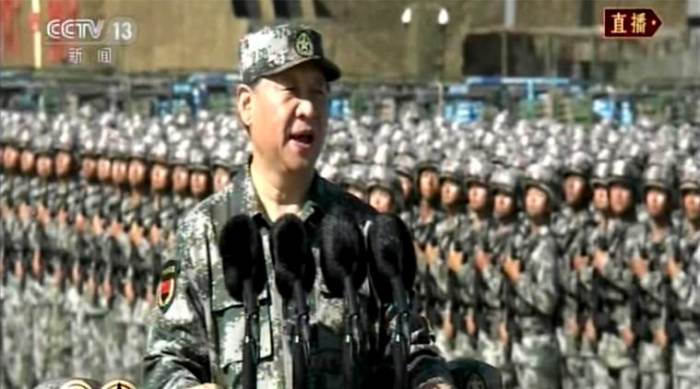
        An entire post cowering behind the apparent safety of their compound walls instead of discharging their duty when humanity is being raped and murdered all around. When the compound too becomes unsafe, they emulate their Pakistani friends’ favourite battlefield tactic – they run away! And this is the bunch of (fill in the blank) with which the PRC threatens the battle hardened Indian Army today!

        Now coming to another interesting nugget I discovered when searching for more info on this incident. I came across THIS report. It was the Indian Army that saved their sorry backsides. The report itself doesn’t mention the abandonment of posts by the PLA peacekeepers. Very ‘convenient’ omission, I say.

        However, as per the report, INDBATT II, comprising of the men of 7th Battalion The Kumaon Regiment, who were held in reserve, were asked to take charge and restore the situation, which they did with extreme professionalism and ruthlessness. Here’s a typically modest way the news report chose to describe their actions – ‘It was learnt that troops also secured the perimeter which was smashed by the IDPs and ensured the armed militiamen were weeded out.’ Yes, they ‘secured’ the perimeter and ensured the armed militiamen were ‘weeded out’. Typical Indian media’s way of underselling themselves. Or perhaps, something that they are so used to from the Indian Army, that they take it as a matter of fait accompli – Send in Indian troops, job will be done.

        Btw, it was the same militiamen who had scared the hell out of the famed PLA troops and routed them that the Kumaonis calmly ‘weeded out’. Rest of the report makes for an interesting read too.

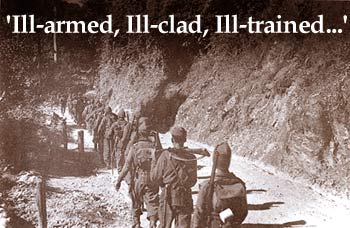
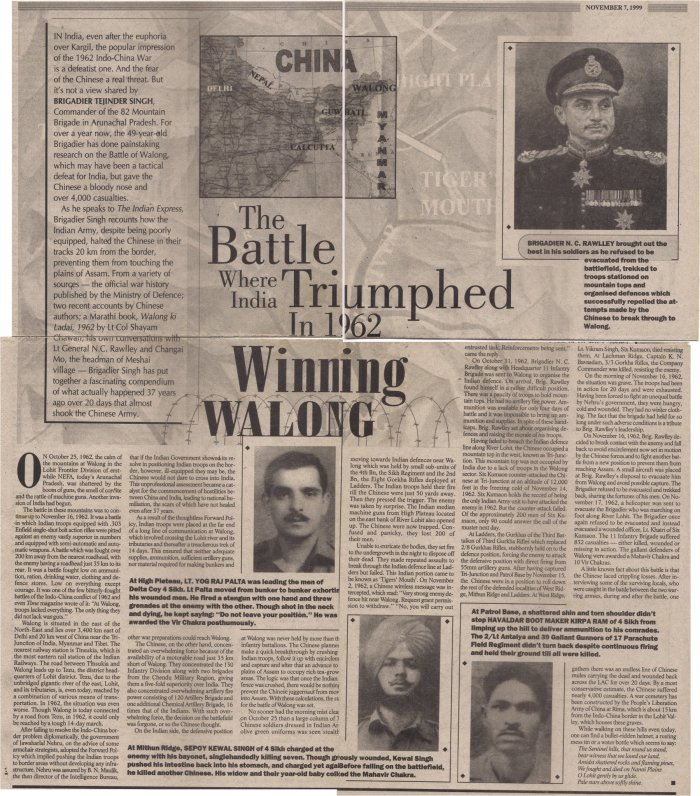
        So here it is. An Army that fought its last war in 1979, an army that has ‘won’ against an outsider only once in 5000 years of its nation’s history, in 1962, was exposed for what it was – shiny toys and scared brats afraid to wield them when time comes. (Regarding the ‘war experience’ of the PLA, that is a blog post which will come in another few weeks, btw)

        Sabre rattling in front of apparently weaker neighbours is fine, but god save you if the ‘weaker’ neighbour draws out his own sword!

(Oh, btw, the title of the photograph of PLA Peacekeepers posted on top of this blog, in The Guardian report is – Peacekeeping troops in South Sudan ‘underperformed’ during violence in July.’)

        ’nuff said!

ADDED LATER: 1 Executive Summary of the Independent Special Investigation into the violence which occurred in Juba in 2016 and UNMISS response (A very diplomatically worded report, with some tight slaps to those concerned)

(Next blog: Story of the two PLA soldiers in South Sudan and who killed them.)

Bhutan and Its Neighbours: The Tango

(Continued from my previous BLOG on Bhutan China Border Dispute. This post should not be seen in context of the ongoing standoff at Dolam, but from a detached perspective. Views are my own. Feel free to disagree)

        Although India’s influence over Bhutan is acknowledged by China, New Delhi is keen to keep an eye on the Sino-Bhutanese negotiations, which would definitively have repercussions on India’s own engagement with China. History as well as geography have given India a huge advantage in Bhutan. In addition, India’s own rise has reduced the relative disparity in military and diplomatic power with China. This blog post attempts to look into the interplay between India, Bhutan and China as each jockeys for position relative to the other two.

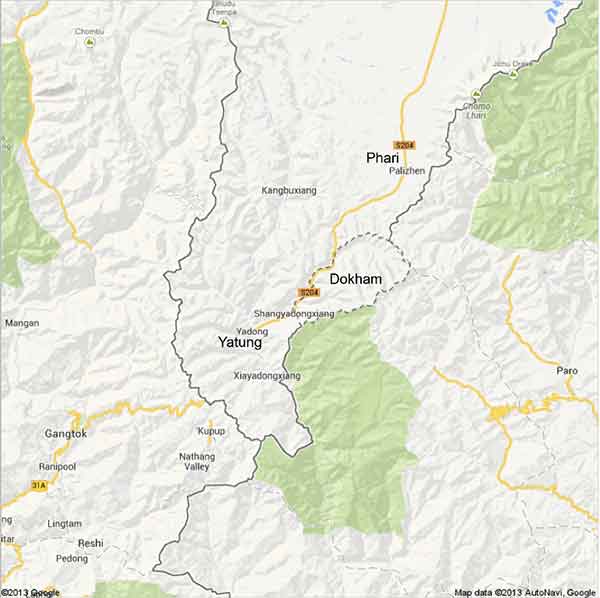
Chumbi Valley

ui

        India’s concerns centre on the Chumbi Valley, a narrow protrusion of a part of Southern Tibet separating Bhutan from the Indian state of Sikkim. It is a tri-junction of China, India and Bhutan and enjoys unparalleled strategic imp in the region. Being close to the Siliguri Corridor, any Chinese thrust down the Chumbi Valley will cut off India’s only land link with its NE states. It will also pose a threat to Kolkata as well as the plains of North Bihar.

        The Chumbi Valley is extremely narrow, only 40km wide in its narrowest stretch, thus making it a Chicken’s Neck for China. This is the reason why China seeks to extend its expanse by incorporating the neighbouring Doklam Plateau of Bhutan (Mentioned as Dokham in the map above). Doing so will marginally improve the Chinese position by increasing the width of the area it controls.

        Ever since the boundaryy dispute with Bhutan, Doklam has been their primary focus, as is evident by repeated incursions into the area and the 1996 offer to let go of Chinese claims in North Bhutan in lieu of the Doklam Plateau. In addition, the Chinese have constructed new roads in the Zuri and Pheetogang ridges overlooking the Charithang Valley (SOURCE), a recent addition to Chinese claims across the Chumbi Valley. An area of concern for India in this respect is the recent joint technical survey of disputed boundary in North Bhutan which has not yet been declassified. India is apprehensive that this might follow in the Doklam Plateau as well, as a precursor to a possible settlement in future which might be detrimental to Indian interests.

India’s Increasing Clout

        With increasing clout in international affairs, any Chinese gains in Bhutan – diplomatically or militarily – would be inimical to India’s international standing. China too is aware of the same, and of the unsaid, but implicit guarantee of protecting Bhutan’s sovereignty by India. Given the rapidly closing gap between relative power of the two nations, China might be tempted to utilize a ‘victory’ in the boundary dispute with Bhutan to undercut India’s international as well as regional standing.

Bhutan as a Buffer

        As with Nepal, Bhutan too is a buffer state between India and China. Recent events in Nepal have highlighted the growing Chinese clout in the country and the consequent failure of Indian diplomacy, along with the setback to Indian interests. In case the same is repeated in Bhutan, implications for Indian interests will be far worse. Apart from making defence of Siliguri Corridor difficult, India’s fight against the insurgent groups in North East will also suffer a setback. Thus, Bhutan’s position with respect to China makes its border resolution decisions key from a security point of view for India.

        For much of recent past, Bhutan and India have enjoyed extremely cordial relations. This continues even today due to past legacy and a pragmatic understanding of mutual benefits. At the same time, India has huge economic and security stakes in Bhutan. However, there is also a growing understanding amongst Indian policy makers that Bhutan has the right to calibrate its stance with respect to its neighbours. Long used to being its window to the world, New Delhi now is coming to terms with the fact that Bhutan is more likely to make choices apart from India. This is more evident in light of the recent transition of Bhutan from monarchy to democracy, potentially giving a platform to the tiny minority that advocate closer relations with China, even if at cost of Indian goodwill.

Indian Outreach to Bhutan

        India has huge economic and military stakes in Bhutan. Bhutan has traditionally been the largest recipient of India’s foreign aid. In FY 2013-14, India’s budgetary support to Bhutan was $600mn. It rose to reach #985mn in FY 2015-16. In addition, Bhutan’s Prime Minister, Tshering Tobgay also secured and additional aid package from India worth $819mn during his visit to New Delhi in Aug 13. This included approx $100mn worth of economic stimulus package for Bhutan’s slowing economy by India. Apart from financial assistance, India also operates three hydel power projects in Bhutan, with another three under construction at present.

Visit by Prime Minister Narendra Modi

        Bhutan was the first country visited by the PM, within a month of assuming office. This sent out a message to all concerned that India valued its relationship with Bhutan as one of the most important ones in the neighbourhood. The visit was also partially necessitated after misgivings within Bhutan by a massive reduction of Indian oil and gas subsidies that was said to be attributable to suspicion that Bhutan’s former Prime Minister Jigme Thinley was carrying out parleys with China. However, the outcome of the visit was positive and termed by the media as a ‘charm offensive’ that would further cement the close ties between the two countries. In fact, PM Modi tweeted on his trip, “World talks GDP but in Bhutan its about National Happiness. Am sure having India as a neighbour would be 1 of the reasons for the happiness.” Thus he underlined the special relationship between India and Bhutan.

ANALYSIS

        While Bhutan and China have common interest in the normalisation of bilateral relations, their perspectives remain different. Yet, it is logical to assume that China – Bhutan outreach that started in 1984 may eventually result in establishment of diplomatic ties between the two nations. However, both sides are also thought to have reached an understanding that this can only follow in wake of the resolution of the boundary dispute. Indian factor will also remain a key element in Bhutan’s China policy.

Trade

        China would, no doubt, seek to normalise its relationship with Bhutan at the earliest. On possible methodology of achieving the same could be through a boost to Sino-Bhutan trade through non disputed parts of the IB. A template already exists wherein Mongolian economy was reoriented towards trade with the PRC after the collapse of the USSR. However, at present Bhutanese economy is primarily geared towards trade with India, both as a source of its imports as well as exports. Thus, Bhutan will have to assess the potential consequences for its own economy if it reaches out to China. Additionally, increased trade with China would necessitate construction of roads in the Northern part of Bhutan. China is likely to be ready to finance such projects as it did in case of Nepal. But given the disputed nature of parts of IB, such construction will have military implications as well.

        Despite the expected betterment of relations, it is unlikely that Bhutan will explore the possibility of using China to balance the influence of India. Bhutan’s China policy is likely to have limited objectives in short to medium terms, primary amongst them being securing a comprehensive agreement on the boundary dispute. At some level, Bhutanese apprehensions over the ultimate objectives of Chines policy in the region is somewhat based on India’s own apprehensions on the issue. Though not related technically, discussions on Sino-Bhutan boundary dispute and those on Sino-Indian boundary dispute seem to be politically related.

        Bhutan seems to be coming round to the conclusion that it is indeed a buffer state between India and China and that its own boundary dispute with the latter is partly due to the state of relationship between the two. This is underlined by the amount of interest shown by China in the Doklam Plateau region. As a result, it is likely that Bhutan may seek to reach out to China on its own terms instead of being ‘guided’ by India, in order to seek a settlement favourable to Bhutanese interests, in case a government suitable oriented comes to power in Thimpu, though that seems far from likely at present. The annual border talks and increasing interactions between Bhutan and China has been creating a positive environment that could result in a normalisation of their relationship in some form.

        India too appears to be coming round to the conclusion that Bhutan has every right as a sovereign nation to establish diplomatic / bilateral relations with any country, including China, if situation so permits. Opening of trade and tourism with China would result in Chinese investments and the consequent increased in Chinese clout. However, Bhutan is unlikely to agree to any settlement with China that will be detrimental to Indian interests. It may be attributable to the following factors:-

  • Historical legacy of bilateral relations.
  • Huge Indian influence in Bhutan in all spheres.
  • Resurgent Indian military power in the region, leading to a closing of the relative disparity with China.
  • Geographical constraints which result in Bhutanese dependence on India for outreach to rest of the world.
  • A perceived ‘fear’ of China in Bhutanese minds, given the aggressive posturing by the PLA in disputed areas.

CONCLUSION

        Bhutan’s relationship with either India or China cannot be viewed in isolation from one another. Bhutan has a complex trilateral relationship with both its large neighbours, leading at times, to it getting caught up in the adversarial relationship between the two. Historical legacy as well as current state of relations indicate that Bhutan is more comfortable with India, and increasing contacts with China are merely an assertion of Bhutanese independence and a desire to maintain cordial relations with all its neighbours, without distinction.

        China too realizes its limited leverage in Bhutan, given critical Indian centrality in Bhutanese affairs, due as well, to the sheer geographic advantage that India enjoys. As of now, all that China seems to want from Bhutan is for it to follow an ‘independent’ foreign policy. As a sovereign nation, Bhutan has every right to establish diplomatic relations with any country, including China. However, given the nature of Sino – Bhutan relationship in past, it is unlikely that Bhutan will take any decision on its boundary issue without taking into account Indian concerns.

        Thus, it can be safely assumed that while Bhutan may eventually open up to China and the rest of the world, India as of now, has no cause for concern. Diplomatic engagement between Bhutan and China is unavoidable, in fact it is beneficial in that it may serve to reduce tensions on account of the boundary dispute and prevent a military misadventure which might see India get involved on the Sino-Bhutan border, assuming that Bhutan will continue to remain aligned with Indian interests on the same.

Bhutan – China Boundary Dispute: A Historical Perspective

Capture.PNG

(Note: The location of current standoff on the India – China – Bhutan trijunction will be referred to as ‘DOLAM’, with ‘DOKLAM’ referring to the area claimed by China West of Thimpu hereafter)

            It is amazing what wealth of knowledge exists on the www, esp when you go looking for answers to something you had no clue about. Did some digging around on the www on to get a perspective about the current standoff, which most people forget that Bhutan too is a part of!

            At first glance on a world map, the Himalayan Kingdom of Bhutan would not seem to be a nation that would factor in the geopolitical calculus of major regional powers. Its relatively small size, population and economy compared to its neighbours India and China, alongwith stated policy of neutrality with respect to both would imply lack of interest by its large neighbours. However, very often Bhutan has increasingly found itself caught up in a discrete, yet high stakes diplomatic battle between India and China. This time round, the battle has moved from being a discrete diplomatic one to an open military standoff between the two large neighbours, on Bhutanese territory.

            The genesis of this dispute lies in two major factors. Firstly, the Indo – Bhutan Treaty of Friendship, which gave India a foothold into the Kingdom of Bhutan much before China and Bhutan became neighbours. Second factor is Chinese claims over Bhutanese territory in three different sectors, which has kept the relationship difficult for more than half a century.

            Bhutan has historically had strong cultural, historical, religious and economic connections to Tibet. Despite these being strained when Bhutan sided with the British Empire in its war with Tibet in 1904, Bhutan continued to have a permanent representative in Lhasa. Bhutan and China never shared a common boundary till China’s annexation of Tibet in 1950. Following the 17 Point Agreement between the local Tibetan Govt and the PRC, Bhutan withdrew its representative from Lhasa. Relationship was further strained when in the aftermath of the 1959 rebellion in Tibet, the 14th Dalai Lama escaped to India. An estimated 6000 Tibetans fled to Bhutan and were granted asylum, although the border was subsequently closed on account of fear of more refugees.

Sino – Bhutan Boundary Dispute

Bhutan recognized China as a significant threat for the first time after the joint Chinese / Tibetan invasion of Nepal in 1792-93. However, these concerns died down after China came under imperial rule and Bhutan became a protectorate of British India. Yet, in 1910, the Manchu Govt claimed Bhutan as Chinese territory, in the aftermath of the treaty between Bhutan and British India. Soon after annexing Tibet, in 1954 China officially laid its claim over Bhutan by publishing a map in “A Brief History of China” depicting a considerable portion of Bhutan as a pre-historical realm of China.

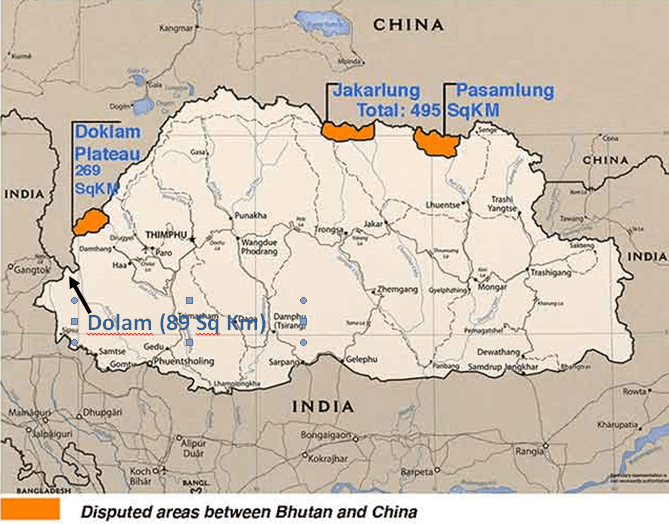
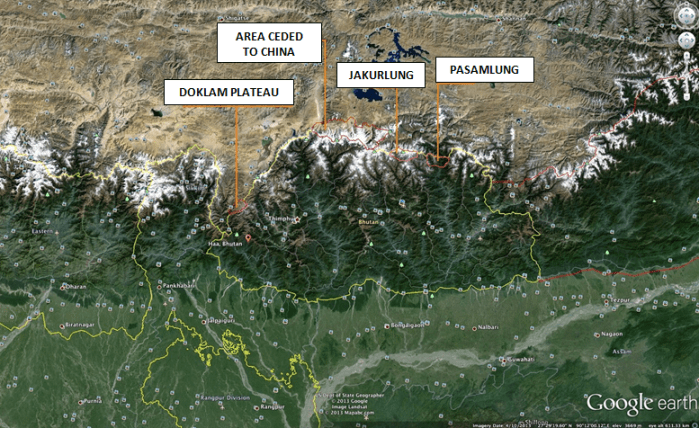
            This was followed up by publication of another map by China in 1958, again claiming large tracts of Bhutanese territory. However, this time China also physically occupied approx 300sq miles of Bhutanese territory. This forced an anxious Bhutan to take recourse to its decade old Treaty of Friendship with India with respect to advice regarding its external relations. The 1959 Tibetan rebellion and its aftermath soon followed, alongwith repeated claims by Chinese leaders over Bhutanese territory. Chinese claim over Bhutanese territories primarily constitutes Jakralung and Pasamlung Valleys on the North-Central part of the Sino – Bhutan border and the Doklam Plateau (As depicted in the map above) in Western Bhutan, along with Dolam near the trijunction.

 Military Provocations

            Military intimidation followed by diplomatic offensive was an important part of China’s policy towards Bhutan in initial days. After Bhutan closed its border, trade and all diplomatic contacts with Tibet in wake of 1959 rebellion, China resorted to significant military posturing in 1966.

            The incident occurred when on the tri-junction of Bhutan, Sikkim and China, Tibetan grazers accompanied by Chinese troops entered the Dolam pastures (Also the site of the current standoff). China subsequently formally extended its claim to aprox 300 sq miles of Northeastern Bhutan and also substantial areas North of Punakha, former capital of Bbutan. When Bhutan requested New Delhi to raise this matter with Beijing, China rejected talking to India saying that the issue concerned China and Bhutan alone and ‘the Indian Govt had no right whatsoever to intervene in it.” A similar incident occurred in 1979 too.

            In the 1962 Sino – Indian war, Bhutan had permitted use of its territory for withdrawal by Indian troops. However, India’s defeat in the war raised concerns about her ability to defend Bhutan. This, in fact, led to an official policy of neutrality by Bhutan.

 Diplomatic Engagement

             The Chinese maintained a policy of carrot and stick with respect to Bhutan with the aim of reaching out to the King. In 1971, China voted in favour of Bhutan’s membership to the UN, thus implicitly recognizing Bhutan. However, Bhutan’s strong support to India in UN over the Bangladesh issue, accompanied by a tour of Bangladeshi refugee camps by the King and subsequent recognition of an independent Bangladesh, dissuaded China from further overtures.

            In 1974, China sent a high-level delegation for the coronation of the new King of Bhutan. Later, in 1977, Bhutan voted in favour of China over India on who should represent Cambodia. With the Janata Party govt that came to power in India in 1977 taking steps to normalize relations with China as part of its policy of beneficial bilateralism, China pushed ahead for commencement of border talks with Bhutan.

            Bhutan was unprepared for commencement of talks with China on the border issue and signalled unwillingness for the same. China upped the ante by large scale intrusions in 1979. Both India and Bhutan formally protested against this intrusion. However, Beijing ignored the Indian protest and responded to Bhutan’s complaint only. This finally brought Bhutan to the negotiating table in 1984.

Establishment of Diplomatic Relations

It leaked out that prior to commencement of talks, in 1983, Bhutanese Foreign Minister Dawa Tsering had met the Chinese Foreign Minister Wu Xeuqian in New York. Wu wanted a Chinese embassy in Thimpu where the only embassies at that time were those of India and Bangladesh. But India prevailed upon Bhutan to decline the request. The Bhutanese Monarch, King Jigme Singye Wangchuk then opted for annual, direct bilateral talks over the border dispute. Countries sympathetic to China inferred that India had been hoodwinked by Bhutan. However, a counter view too existed that New Delhi preferred it this way, guiding and advising Bhutan from behind the scenes.

            In 1988, the two countries agreed on Four Guiding Principle for further talks. These included maintaining peace along the border, something China often violated to create pressure on Bhutan.

          In 1996, China offered a package deal to Bhutan. Beijing was ready to renounce its claim over the 495 sq km of disputed land in the Pasamlung and Jakarlung Valleys in exchange for the 269 sq km it claimed in the Doklam Plateau. This was rejected by Bhutan. In 1998, China finally signed a peace agreement with Bhutan to ‘maintain peace and tranquillity on the Bhutan-China border areas.’ The Bhutanese were encouraged to sign it since Beijing admitted as part of the text of the agreement that ‘China fully respects the territorial integrity and independence of Bhutan.’

Sino – Bhutanese Relationship in the New Millennium

The new millennium dawned with a resurgent and confident China, with enough military and economic clout at its disposal. The Chinese attempted to utilize this to force a favourable resolution of the large number of territorial disputes with neighbours, incl Bhutan. Chinese outreach to Bhutan is summarized as under:-

       Periodic incursions by PLA troops into disputed areas, alongwith threats to Bhutanese personnel manning the same that they are in Chinese territory, in order to maintain pressure on Bhutan.

        In Jul 2002, Bhutanese Foreign Minister Lyonpo Jigmi Y Thinley told the National Assembly that the Chinese had claimed to have documentary evidence on the ownership of the disputed tracts of land. When Bhutan asked them to be generous with a small neighbour like Bhutan, they said that, as a nation which shared its border with 25 other countries, they couldn’t afford to be generous with one particular neighbour. The Chinese Govt were unhappy and questioned why Bhutan was raising new issues after many years of talks. However, no details were released regarding these new issues.

Bhutanese Interpretation of International Boundary in Disputed Areas

           According to debates that took place in Jul 2002, there were four basic dispute areas described as: “Starting from Dolam in the West, the border goes along the ridges from Gamochen to Batangla, Sinchela, and down to the Amu Chu. The disputed area in Dolam covers 89 sq km. The disputed areas in Sinchulumpa and Gieu cover about 180 sq km. The boundary line in this area starts from Langmarpo Zam and goes along the stream up to Docherimchang and up the ridge to Gomla from where it goes along the ridge to Pangkala and then down to the Dramana stream. From Dramana, the boundary goes up to Zingula and then follows the ridge line down to Gieu Chu from where it goes to Lungkala. In the middle sector in Pasamlum, the boundary goes along the ridge to Dompala and to Neula. From Neula, the boundary follows the ridge line to Kuricchu Tshozam, and then follows the ridge line to Genla from where it goes to Mela and onwards to the East.” As a result, the disputed territory was reduced from 1128 sq km to 269 sq km in three areas in the north western part of Bhutan.

dg.PNG

       During his visit to Bhutan in Apr 2003, Hua Junduo, Chinese Ambassador to India, reiterated China’s friendly, good neighbourly stance towards Bhutan. He said that while there are no formal diplomatic ties between Bhutan and China, the relationship was developing in a positive way, and actual relationship was more imp than formal diplomatic ties.

       After a surprise meeting between Bhutanese PM, Jigme Y Thinle and Chinese Premier Wen Jiabao on the sidelines of the Rio +20 Summit in Brazil in 2012, the Chinese media quoted Wen as saying, “China is willing … to establish formal relations with Bhutan, resolve the border issue between the two nations at an early date, strengthen exchanges in all areas and advance Sino-Bhutanese relations to a new stage.” However, there was no corresponding confirmation from Bhutan. It was later reported that Thimpu had clarified to New Delhi that they had not given any commitment to Beijing yet.

        In Apr 2013, Zhou Gang, a former Chinese Ambassador to New Delhi, was sent to Bhutan as a special envoy of the Chinese Govt, carrying with him a blunt message: ‘If you want to settle the boundary dispute with us, allow us to open our mission here.’

       In 2013, Thimpu had endorsed its acceptance of a technical survey instituted to settle the boundary dispute in the Pasamlung sector of the country. The same was acknowledged in the 23rd round of boundary talks held at Bhutan in Aug 2015 and both sides spoke positively of it.

This, in a nutshell, is where the Sino – Bhutanese relationship stood with respect to their boundary dispute before the Chinese tried to force their way across the International Boundary in the Dolam plains near the Tri-Junction area.

Thoughts on Recent Doklam Standoff

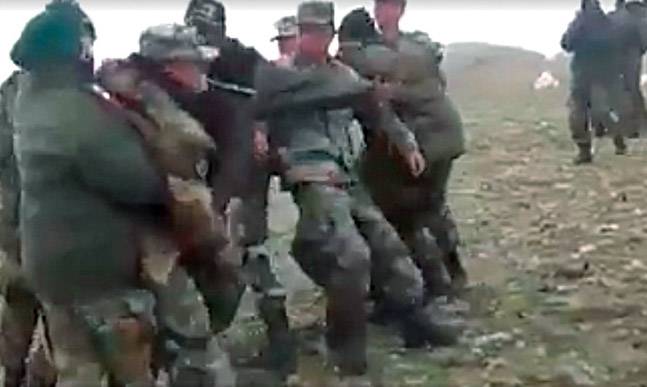
video_070717013541

(Photo: A video grab said to be of Indian and PLA troops facing off in the Bhutanese territory in Doklahm)

Sharing some ramblings on the recent Doklam incident between India and China. Strictly my personal opinions.

The current world order is a result of two devastating world wars in which the stakeholders threw in all that they had in terms of men and material. Each of these wars was a mighty bloody affair. And then came the spoils which the victors claimed for themselves, and their lackeys, be it permanent seats at the UNSC, P-5 Status, NSG, IMF .. and the works. Even a break up of the Soviet Union wasn’t sufficient to change this world order, though it ‘hobbled’ a bit for sure. What is happening now is the rise of China which is a possible catalyst for a recalibration of the current world order. I call it a recalibration ‘coz China is still already at the high table of the UNSC / P-5 / NSG etc. This recalibration involves displacement of the West as the foremost military as well as economic power in the world. Utterances about G-2 notwithstanding, the Middle Kingdom aims to stand alone with the rest of the world under its thumb. It is here that geography might end up putting a spanner in the PRC’s works. More specifically, the neighbourhood it gave to itself after the invasion of Tibet soon after formation of the PRC. Here’s a Tweet from Feb 2012 (“Did China and India ever share a common political border before 1950?”).

Now with India and China together ascendant at the same time after a long while, along with a shared boundary too, friction is bound to occur as both jostle for the same geopolitical space atleast in the neighbourhood for the time being, neighbourhood that extends from Japan to Iran / Afg. Given the history of 1962 as also 1967 & 1986, mutual trust is at a premium. Then there is the question of gap in relative military capabilities which India is working hard to bridge. Recently cleared acquisitions (Tweet:  “Anatomy of China land disputes-Claim others’ land,settles for partial gains. India is only 1 actually claiming land occu by China #AksaiChin”) will start arriving in the next couple of years – Rafale, LCA, Dhanush, Vikrant and the works. Point is, the window for ‘Showing India its Place’ once again, is closing rapidly. A conscription based PLA army which turns over bulk of its troops every 3-4 years vs a well bloodied, all volunteer Indian Army with new acquisitions coming online soon will be an ‘interesting’ match to witness. That Doklam is strategically important enough to be denied to the PLA is not in doubt. But for all the hoopla around it Chinese access to Doklam is still via the Chumbi Valley that only narrows down close to Doklam. Not going into tactical aspects out here, but what I personally feel is that Doklam might just have been a ‘probe’ to gauge Indian reactions, pending further course of action. This time round own folks handled the situation fantastically, both at political as well as military levels.

But it hasn’t played out fully as yet, despite going away from media glare fore time being. In any case, given the current monsoon season, nothing much could have been done militarily by either side. Let the monsoons finish, say from Sep onwards before we can safely say that the current stand-off is truly over. Weather does play a big role out here – 1962 happened in Oct-Nov, 1967 in Aug-Oct & 1986 again in the same time period. Keep the gunpowder dry till then. Alternatively, this Doklam thing could merely be a diversionary tactic, with real intentions lying elsewhere, say in Mana / Badrinath / Kedarnath and thereabouts. Point is, if the PRC really wants to insure its rise WITHOUT India challenging it, a visible military engagement with a visible victory is essential for the PLA. And the window for that, if not already closed, is closing rapidly. Same goes for us, as we look for a seat at the high table of the UNSC / NSG etc. Bottomline is that no one will just give it to you if you are a good boy .. they earned it after catastrophic events -world wars, nukes cold war etc. To think that they will just make space for India at the table is being utopian. To this effect, a military clash with China, ending on terms favourable to us, may not be a very bad idea. PRC knows too!

JMTs / Rambles. Take it FWIW.