This chain of thoughts was shared on twitter on the night of 17 Jan 2025. Link to the thread on twitter : https://x.com/CestMoiz/status/1880267596702052855
Folks, Sharing snippets from my trip to Prayagraj to witness the Maha Kumbh earlier this week. Missus and I spent four days and five nights in the city, reaching there on the night of 11 Jan and returning back home on the night of 16 Jan.
Here goes ..
First and foremost, MUST plan a trip to Prayagraj for the Maha Kumbh!
It is a once in 144 year event and we are blessed to be alive at this point in time to be able to witness it. For so many people, a Maha Kumbh won’t ever be even a once in a lifetime event.
As we drove into the city, we could sense magic in the very air. The entire city was in an upbeat mood, despite waves after waves of humanity descending there. Thankfully, we had booked our stay in the month of October itself and were comfortable that way, unlike many others.
Having parked our car, we just let it remain there for the next four days. This was partly due to us not quite knowing the city and partly also because of the traffic restrictions put in place by the police in order to facilitate the floods of pilgrims that had come for the event.
We realized later that the massive crowds were there because the first two days of the Maha Kumbh, i.e., 13th and 14th Jan were for Shaahi Snaans of Magh Poornima and Sankrant. After Sankrant, the crowds visibly thinned down. Will come to that in a while.
Morning of 12th was our first day in the town. We took a rickshaw for the Ganga Ghat near Naag Vasuki Mandir. Thankfully, the rickshaw driver lost his way and we ended up across Maa Ganga, at the entrance to the Mela Grounds!
We entered the area & were pleasantly surprised to see the arrangements put in place by the administration. The various ‘shivirs’ were very well laid out. The entire area is divided into a vast grid with lanes criss-crossing each other at right angles, making it easy to navigate.
The pathways are paved with metal boards for ease of driving for vehicles permitted inside the Mela Grounds. The various ‘Shivirs’ too are fairly well decorated, depending on how deep the pockets of the organisers are!
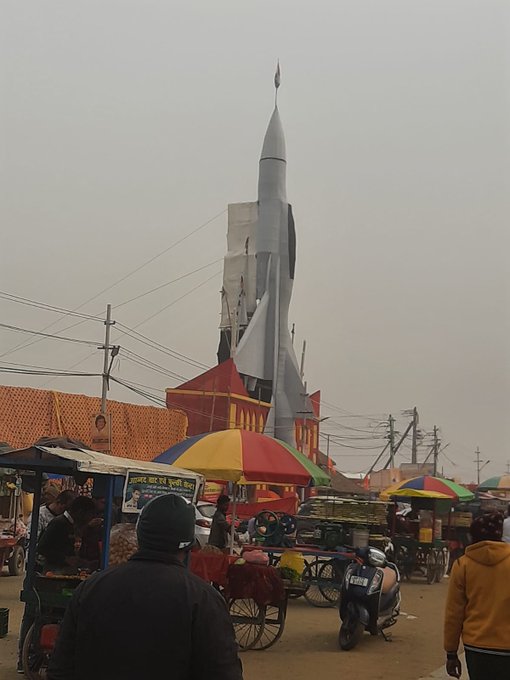
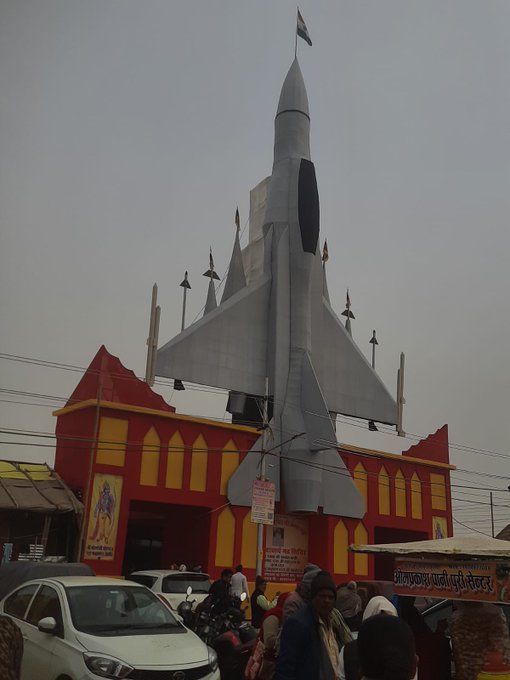
Sharing one particular camp that I found really interesting!


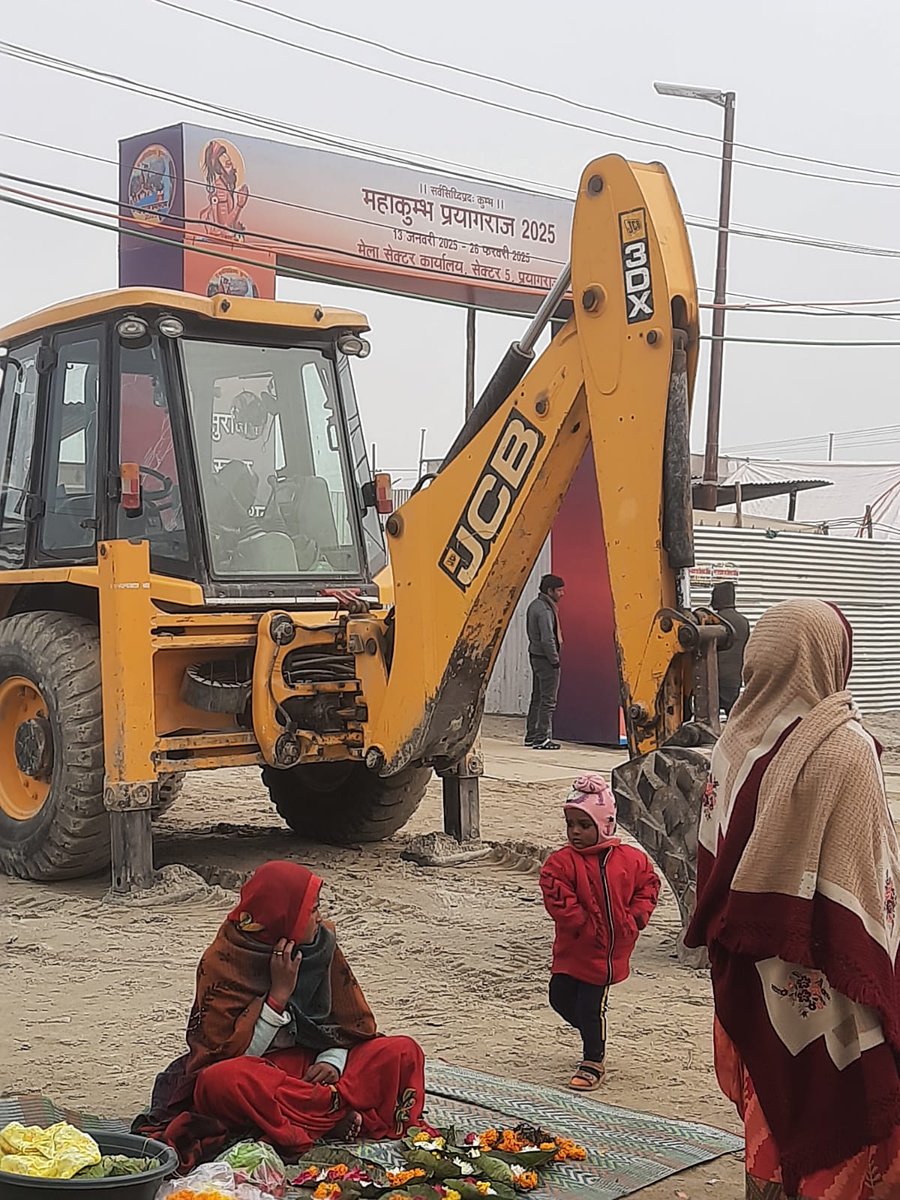
And of course, it being UP, Shri JCB Ji was there as well, though this time for a very benign purpose!
The sheer Bhakti and Devotion that the crowds from all over the country brought along with them was something that could be felt in the very air we breathed. I kid you not when I say that it was almost as if one could actually ‘see’ the beautiful vibes in the air.
The first day was spent volunteering at a Shivir where tea / bhandaara was a continuous affair from 5am till 11pm every day. Three out of our four days were spent volunteering at this Shivir, in fact. Such was the bhakti, that the person managing the Shivir had actually quit his job to be able to spend the 50-odd days there, managing and serving for nearly 18 hours a day, along with his wife & kids. They all and some more volunteers were in fact staying within the camp itself.
Serving food to folks from different strata of society was a strangely spiritual experience. One could see that devotion in even the poorest of the people. And also see how content many of them actually are. They took extra care to ensure not a morsel was wasted, and only took just as much as they needed. This included packed meals for a parent or a child or even a sibling who wasn’t able to come for the Bhandaara. All prasad was gratefully and smilingly accepted and consumed.
Talking about the prasad, the first day’s fare was kadhi-chawal. Once again, I kid you not when I say that even though cooked in bulk, it tasted heavenly. The only reason that I can fathom for that is the Bhaav with which the cooks were preparing the prasad. They worked round the clock, but with the same energy throughout the four days that one saw them, regardless of the time of the day.
This brings me back to the arrangements. Each ‘Shivir’ had an electricity connection and atleast 4-5 tap water connections with water supply at good pressure throughout the day. The sheer logistics of it all are actually mind-boggling.
Then there were the Safai Karmachaaris. I had read somewhere before coming to Prayagraj that nearly 10,000 Safai Karmacharis were employed. While there, I could actually see them in action, working without supervision and ensuring cleanliness of the highest order.
Hats off indeed!
They would invariably form a decent chunk of those coming over for the Bhandaara as well.
In fact, it was an eye-opener for me to note that the entire city of Prayagraj is amongst the cleanest ones that I have visited thus far.
And I say this after having seen Indore as well.
There were more than adequate sanitary facilities as well for both genders that too were being cleaned almost round the clock by dedicated safai karmachaaris.
By the evening of our first day in the Mela Grounds, it became a bit cold and there was a light drizzle as well. This had me a bit worried.
Why?
Because next day was the first day of the Maha Kumbh and we planned to take a dip in Ma Ganga in the morning!
And I was already shivering!
So here is how the next day went ..
But before that, a quick word about the local police. They are on duty everywhere, as are thousands of additional policemen requisitioned for the duty. They stand on their posts in bitter cold, amidst a sea of humanity out there in full force. Yet, each and every policeman that we stopped by to ask for directions or any other information, was really polite and actually happy to help. Not just us, but the 100s more that would have stopped to seek guidance from them.
As I said before, the entire air was alive with Magic!
Coming back to the morning of the 13th.
It was the first day of the Maha Kumbh and we planned to take a dip in Ma Ganga at the Dashashwamedh Ghat instead of going to the Sangam that day. We got up early and moved out.
Btw, this time I was wearing a newly purchased chappal instead of the leather sandals that I wore the previous day because they had given me a shoe-bite! Looking back, I think it was only appropriate because I dared to wear leather in the holy Mela Grounds!
So we hailed an e-rickshaw and he promised to take us as far as the police would permit!
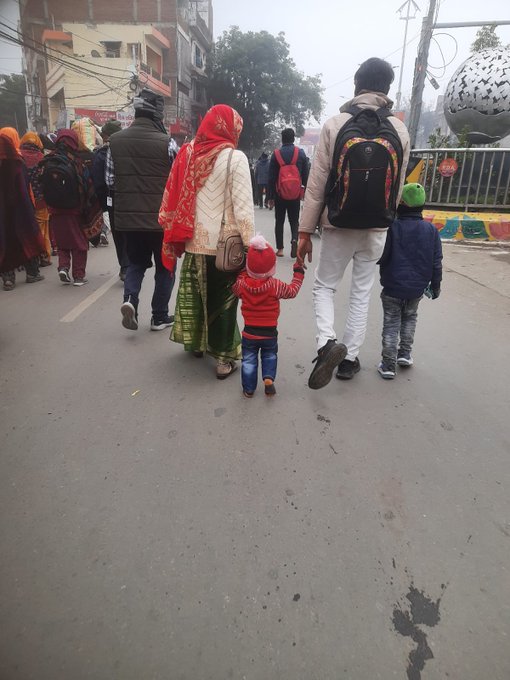
This meant alighting about 2km before ‘Daaraganj’ and commencing our walk as part of the large throngs of devotees headed that way. This pic was clicked by the Missus that morning. It perfectly captured the faith and devotion of folks who travelled that way from each and every part of the country. I’ll just leave it here without any further comment.
Thankfully, we were able to find an e-rickshaw after walking for about a kilometre. Apparently, some were voluntary ‘stuck’ on the other side of the barricades and would only ply within that area because once out of there, they would not be permitted back in!
Thus we reached the Ghat. Heartbeat grew faster as the moment of the snaan came closer.
It was partly due to anticipation of the event that had build up over the past 7 months when we had decided to visit the Maha Kumbh, but partly also due to the cold winter morning of that day!
However, a snaan had to be undertaken and so it was.
The waters were cold, no doubt, but the snaan was so beautifully invigorating and cleansing that one cannot describe it in words.
I will try to do so as I talk later in this thread about the snaan in Sangam the next day.
Let it suffice to say that the day just became even more beautiful after the snaan.
Once again the ghaat was really clean and being continuously cleaned all the time as well. There were good facilities for the ladies too to change after the snaan.
And then there was the famous ‘Nimbu-Chai’ as well as my weakness – Cotton Candy. Both were consumed before we walked across Ma Ganga via Bridge 15 – one of the many temporary bridges constructed for the event. The bridge took us straight to the Mela Ground.
This was when I remarked to my wife – ‘Now I understand why it is called a Mela!‘
The previous day, we had entered the grounds from the other end, where there were all the Shivirs. This day, as we entered from the Ganga Ji side, we realized what a beautiful Mela was underway!
There was pure festivity in the air, along with the unmistakable aura of bhakti. So we stopped before going to ‘our’ shivir and had steaming hot bhuna hua chana, with a cocktail of masalas adding to the flavour. Sheer Bliss, I tell you!
As we turned towards the Shivir, a speeding SUV suddenly screeched to a halt. In it was a ‘V.I.P Babaji’ (Copyright for this term rests with Shri @cestmoiz Ji! 😁🙏). The driver was in a rush, even as I signalled with my hand for him to slow down, lest he run over some poor soul!
I made eye contact with the ‘V.I.P Babaji’ while doing so and he politely smiled at me.
But the driver glared at the walkers for daring to slow him down!
Two different sides of a coin, I’d say.
While on the topic of ‘V.I.P Babajis’, on our last day in the Mela Ground, a vehicle crossed us from behind at great speed, with sirens blazing. I thought it was an ambulance, till the time I saw it to be a private vehicle, followed by yet another SUV of yet another ‘V.I.P Baba’!
Anyhow, back to the Mela on day two of our trip which was also the day one of the Maha Kumbh. Once again, the day was spent serving food to folks who came visiting the little Shivir that we were volunteering at.
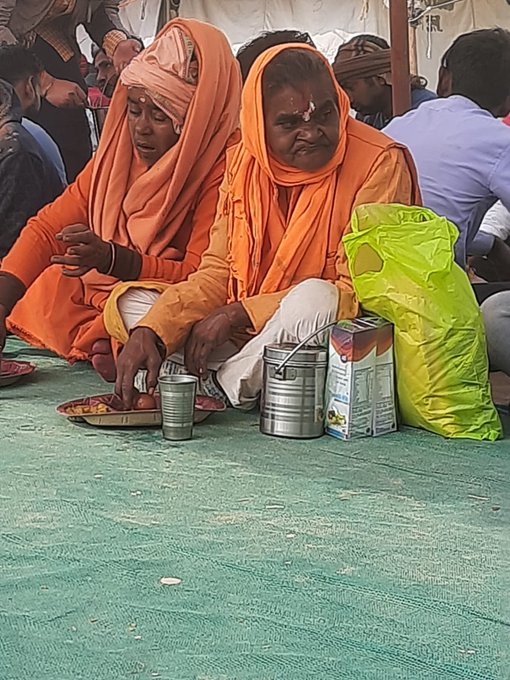
It was sometime in the midst of this that I had an epiphany of sorts.
Where we had spent months and weeks agonizing over planning our trip, where to stay, how to commute etc, many such simple folks had just gotten up and reached Prayagraj, trusting fate to take care of them.
That day the Bhandaara lasted from 11 am till 5pm & was still on as the Missus & I left the camp. On the way out, I couldn’t help but think of all those stories in the movies about kids getting separated in Kumbh ka Mela. It seemed very unlikely that day, seeing the arrangements.
But as luck would have it, at just about that time my wife and I got separated!
Thankfully, she called up on my mobile and we could find each other again, without having to wait for so many years as might typically happen in a bollywood film!
Next day we had planned for a dip in Sangam on the occasion of Sankrant. Sadhus and various Akharas had already taken the dip during the early morning hours of between 3 and 5 am that were reserved for them. We commoners started from our lodgings at about 8:30 am.
This day, traffic was halted nearly 7km from Sangam. Crowds too were massive, even when compared to the day prior. However, crowd control was excellent and there were one-way lanes for pilgrims in order to avoid any ‘dhakka-mukki’.
And unlike the crowds in say, Karol Bagh Market of Delhi, these crowds didn’t make me perturbed or short-tempered. We were all one in our pursuit of the spiritual experience at Sangam.
All energies all around us were pure and blissful as the sea of humans snaked thru the streets.
The crowds were really thick, but one never felt claustrophobic. Space and traffic management was excellent and never once did we encounter a ‘traffic jam’. Such was the beauty of the traffic management, that we were even able to halt in the middle of it all and take this video!
The police were very ruthless in restricting access to even fellow policemen in uniform who wanted to reach their place of duty on their motorcycles!
We decided to take a boat to Sangam from the Qila Ghaat. Looking back, this turned out to be a great decision!
For one, the views were fantastic!
The Qila Ghaat is situated on the banks of the Yamuna River. From here, it took about 20 minutes for us to reach Sangam by boat. The boatsmen charged a mere Rs 400 per passenger for the 80-90 minute round trip instead of attempting to rip us off.
There were eight of us on the boat, including four women and a guy from a Gujarati family. They were in great spirits, joking around with each other, with us and with the ‘Kevat’ as well.
Once again, there were hundreds of boats in water and yet, a perfect method to the madness.
At the Sangam, we were taken to an area where there was a sandbar on which water was about chest deep. Once again, a snaan was done, with this time one extra dip devoted to all those who had outsourced their own ‘Paap-Dhulai’ to me upon hearing of my trip!
Once again, the snan was pure bliss. The body and the heart felt so warm after the snan that I cannot describe in words. One could actually sense the changed mood in the boat during the return journey, as the same Gujarati family, after some minutes of chit-chat, started off with Hanuman Chalisa followed by bhajans, with rest of us too joining in.
The walk back was leisurely. The Missus was, however, tired.
And as if on cue, two young guys appeared and offered to drop us off to wherever we wanted, on their bikes which they had managed to bring in!
No price was negotiated and no demands were made. They just said that we could give them whatever we wanted. Naturally, we got on the bikes.
My driver talked all through the ride about doing this as a seva (it wasn’t a taxi!), and offering me advice for rest of my stay there. We reached a few minutes before the other rider reached with my wife. While waiting, he saw I was carrying a pitcher with water from Sangam. He asked for some of it and performed a ‘Panch-Snan’ by sprinkling it on his head, face and feet.
Once the Missus too reached, we paid them what we thought was a fair price, plus some more! Thankfully, they were happy with it.
This brings me to another aspect about the public transport in Prayagraj. Mind you, this is purely based on my anecdotal experiences, so feel free to disagree. I felt that the e-rickshaw drivers too were polite, helpful and not at all overcharging despite so much clientele.
In fact, the entire city of Prayagraj is currently seeing major disruptions in their daily routine. On days of Shaahi Snan, a large chunk of locals cannot even go about their business/jobs or even take out their vehicles Imagine such a thing in Delhi & the chaos that would ensue!
I have no hesitation in saying that entire citizenry of Prayagraj are earning so much Punya merely for hosting the Maha Kumbh and the Kumbh every time they happen.
Then there are the security personnel who continue to be on duty and yet may not be able to have a snaan themselves. In fact, I actually asked one guy on the Qila Ghaat whether he had had the opportunity for a snaan in the midst of doing his job and he was happy to report that he had gone by boat at 3am itself and had a snaan!
So much Bhakti all around ..
That day we couldn’t go to do seva in the Shivir because of the sheer amount of time it took to go to Sangam and come back. The evening was, instead, spent visiting temples outside the restricted zone.
Our fourth and sadly, last day in Prayagraj was the 15th of Jan. It started off as a bitterly cold morning and I half-jokingly mentioned to my wife that instead of a dip, we should only do a ‘Panch-Snaan’ in Ganga Ji. Anyhow, we took an e-rickshaw to go to the Dashashwamedh Ghat.
To one’s surprise, the rickshaw took us right till the Ghat!
There were no traffic restrictions this day, they having been lifted last night after the Shaahi Snaan was over! To add to the surprise, the crowds too had massively thinned out!
We enquired from our rickshaw guy and he told that towards Sangam too, the walk this day would be barely 1-1.5 km! (Note: this was later corrected by someone on Twitter who said that rickshaws can go as close as 200m to Sangam.)
Anyhow, the morning was still bitterly cold and we were already on the Ghaat! However, once there, there was no question of not taking a dip!
This time too, the cold only lasted till one took a dip. After the snaan, it was once again as if it was a different world altogether!
This was our third snaan in three days.
Truly blessed.
Yet another cup of ‘nimbu chai’ and yet another cotton candy was consumed before we made our way across Ganga Ji and into the Mela. This time there were a few announcements for lost kids / companions on the PA system by the administration, as were on the day of the Shaahi Snaan.
We reached the Shivir for seva at 9:30am & left at 8pm. Truth be told, we did not want to leave at any cost.
Yet, life had to go on.
Goodbyes were said to those lucky enough, or resolute enough, to continue to serve, while we left for our lodgings that night.
With a heavy heart, we started back for Delhi at 8am on the morning of the 16th and reached home by evening. The Missus has already decided to go back later next month and is planning to stay in the Shivir itself. I, on the other hand, have a job to go to!
We are told that more than 1.5 Crore devotees took the holy dip on Sankrant. Locals also say that atleast 3-4 times as many will come on the Shaahi Snaan on Mauni Amavasya.
Now THAT would be a sight to behold for those lucky enough to witness it!
Speaking with the locals in the Mela Ground and elsewhere as well, one got the sense of pride they feel in hosting this mega event every 12 years. They were also all praises for the Govt and local administration for making arrangements like ‘Never Before’ in this Maha Kumbh.
As I close this thread, all I will say is JUST GO THERE! Kumbh comes once every 12yrs and a Maha Kumbh once every 144 years. One absolutely must make use of this blessed duration to perform this teerth yaatra while one can. That’s all I will say.
Thanks for your patience.
:fin:



 Harpreet's Blog